Framed, Plaque, or Acrylic? How to Display a Newspaper or Magazine Article
You've decided the article deserves a spot on the wall. The feature on your company, the profile of someone you love, the headline you earned. Now comes the question that stalls most people: what should it actually be? A framed print? A wood plaque? One of those sleek acrylic panels? Metal?
Search around and you'll find plenty of answers, almost all of them from companies that sell exactly one of those formats and conclude, reliably, that theirs is the best. We make framed and acrylic article displays ourselves, so we're not neutral either. But we've talked to enough customers choosing between all four to give you the comparison we wish existed: what each format really looks like on a wall, how it ages, what it costs, and the one thing about plaques that almost nobody mentions before you buy.
The short answer: a wood frame keeps the print removable and reads as a keepsake ($80–$250); a plaque is permanently sealed and reads as an award ($90–$250+); acrylic is frameless and modern ($90–$250+). For original clippings, only conservation framing protects the artifact — everything else is permanent.
The four ways to display a newspaper or magazine article
Every option you'll run into is a variation on one of these:
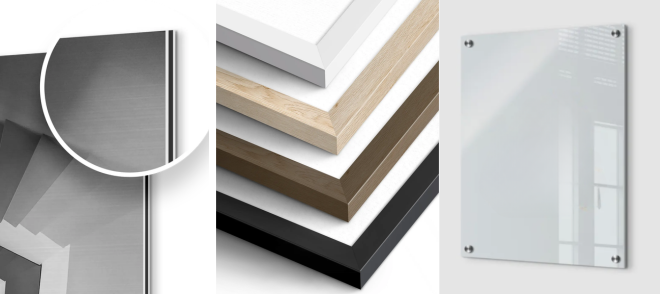
A traditional wood frame. The article is printed (or the original clipping is matted), placed behind glazing, and framed in wood or metal. The classic look, and the only format where the display and the article remain two separate things.
A wood plaque. The article is printed, mounted flush onto a wood board, and sealed under a laminate or heat-sealed finish. Beveled edges, often foiled in gold or silver, sometimes with an engraved plate. This is the format most "newspaper plaque" and "magazine article plaque" searches lead to.
An acrylic panel. The article is printed directly onto (or mounted behind) a clear acrylic sheet, usually with polished edges and metal standoffs that float it off the wall. Frameless, modern, and increasingly the default in offices.
A metal print. The article is printed onto an aluminum panel. Durable and contemporary, though the least common choice for editorial content, and the hardest to make read as a keepsake rather than decor.
A quick word on shadowboxes: a newspaper shadowbox is really a deep traditional frame, used when you want to display the whole folded paper or add objects (a medal, a bib number, a ticket stub) alongside the article. Everything below about frames applies to shadowboxes, with added depth and added cost.
The one thing to know before choosing: plaques are permanent
Here's the detail that vendor pages tend to bury. Plaque mounting is irreversible. Your article is glued or heat-sealed to the board, and it does not come back off. The same is true of direct-print acrylic and metal. A frame, by contrast, is just a container: open the back and the print comes out intact.
Whether that matters depends entirely on what you're mounting.
If you have an original clipping — the actual page from the actual paper — think hard before committing it to a plaque. Conservation framing exists precisely so the original survives untouched. Seal a one-of-a-kind clipping to a board and you've made your display decision permanent, along with any yellowing the sealed newsprint does over the decades.
If your article is online, the calculus flips completely. There is no original. Whatever you put on the wall is a reproduction printed for the purpose, so "preserving the original" stops being an argument for or against any format. The real questions become how the reproduction is made (a proper newspaper-style layout, not a screenshot) and how the format suits your room. If the reproduction itself is the part you're wondering about, we've written a full walkthrough of how an online article becomes a framed newspaper print.
That distinction, original versus reproduction, should drive your choice more than anything in the pros-and-cons list below. It's also the distinction almost every comparison skips.
Pros and cons of each format
Traditional frame
The case for it: Warmth and gravitas. A framed article in a real wood frame reads as considered, the way diplomas and family photos do. It suits the newspaper aesthetic naturally, since newsprint behind glass is how framed articles have looked for a century. It's the only reversible option: you can swap the print, replace the frame, or re-mat it years later. Quality glazing (we use Acrylite, an archival-grade acrylic glazing) blocks UV and protects the print without the shatter risk of glass.
The case against it: Frames have edges and visual weight, which can fight very minimal decor. Glass versions are fragile to ship and heavy to hang. And quality varies enormously: a thin plastic frame with no UV protection will let the print fade and looks like what it costs.
Typical market price: roughly $80-$250 for a custom-framed article, depending on size and materials.
Wood plaque
The case for it: Durable and self-contained. Nothing to shatter, easy to wipe clean, and the sealed surface protects against moisture and handling. Plaques feel substantial in hand, which makes them popular as handed-over gifts and awards. No glazing means no glare.
The case against it: The mounting is permanent, as covered above. The look is polarizing: beveled gold-foil edges read as "corporate award" to some eyes and dated to others, and the laminate sheen can cheapen the newsprint effect. If the sealing is done poorly, trapped acids can yellow the article with no way to undo it.
Typical market price: roughly $90-$250+. Got a plaque mock-up from That’s Great News by email? Here are That’s Great News plaque prices, compared.
Acrylic panel
The case for it: The modern option. Clean, frameless, floats off the wall, and the clarity of the material makes print look sharp and saturated. In our own orders, customers who choose acrylic over a frame almost always say the same two things: they want the contemporary look, and they like that the print is sealed against dust and humidity. Fingerprints wipe off. It photographs beautifully, which matters more than people admit for office walls.
The case against it: Also permanent in its direct-print form. Acrylic scratches more easily than glass, so it wants a microfiber cloth rather than a paper towel. And the ultra-modern look can feel cold next to a century-old masthead. A 1920s family clipping in floating acrylic is a deliberate style choice, not a neutral one.
Typical market price: roughly $90-$250+.
Metal print
The case for it: Nearly indestructible, thin, light, and genuinely striking with high-contrast photography.
The case against it: Newspaper pages are mostly text on a light background, which is exactly what metal renders least warmly. It's the format that most makes an article look like wall art instead of a kept piece of news. Fine if that's the goal, but for most milestone articles it isn't.
Typical market price: roughly $60-$220.
Comparison table: frame vs plaque vs acrylic vs metal
| Traditional frame | Wood plaque | Acrylic | Metal | |
|---|---|---|---|---|
| Look | Warm, classic, timeless | Formal, award-like | Modern, minimal | Contemporary, industrial |
| Reversible? | Yes — print removable | No, permanently sealed | No (direct print) | No |
| Safe for original clippings | Yes, with conservation matting | Not recommended | Not recommended | Not recommended |
| Durability | Good (acrylic glazing: very good) | Very good | Very good, can scratch | Excellent |
| UV / fade protection | Depends on glazing quality | Depends on laminate | Good | Good |
| Glare | Some, glazing-dependent | Low | Some | Low |
| Feels like | A keepsake | An award | A design object | Wall art |
| Best setting | Home, office, gifts | Corporate walls, retirements | Offices, modern homes | Lobbies, industrial spaces |
| Typical price | $80-$250 | $90-$250+ | $90-$250+ | $60-$220 |
Which format for which situation
A family keepsake or legacy article: wood frame. The warmth suits it, and if you're working from an original clipping, the frame is the only format that doesn't commit it permanently.
A corporate milestone for the office: acrylic, or a plaque if your office already has a wall of them. Acrylic matches modern office interiors and shrugs off dust and fingerprints. This is the one situation where we'll tell you a plaque genuinely competes: on a wall of existing award plaques, one more plaque looks intentional and a lone frame looks lost. For press walls and team gifts, see our framed articles for companies.
A gift: frame or plaque, depending on the recipient's home. A frame is the safer read for most living rooms. A plaque suits someone who'd display it on a shelf or desk rather than hang it.
A press feature you want clients to notice: acrylic. It reads as current, and it photographs well behind a reception desk.
The whole front page, or an article plus memorabilia: shadowbox frame. It's the only format built for objects and full folded pages.
If you're already picturing one of these on your wall, you can start with just the article's link and see a proof of the finished layout before deciding anything.
What we offer (and what we'd tell a friend)
We make two of these four formats: framed prints and acrylic panels. In both cases the process starts the same way, because with online articles the display format is the second decision, not the first. The first is the reproduction. We rebuild your article as a real newspaper page (columns, masthead, proper headline treatment), print it with sun-resistant inks, and send you a proof within 48 hours. Nothing is printed until you approve it. Our framed articles run $79 (8x12") to $229 (24x32") in 2026, proof included, and most orders arrive 5–10 days after ordering — and if it’s a gift, no invoice goes in the box.
For frames, we use Ayous wood with Acrylite glazing and a sealed backing, so the print is protected from UV and humidity but never glued down. Years from now you can open it, swap it, or re-frame it. For acrylic, the same reproduced page is finished as a clean floating panel.
What we'd tell a friend deciding between all four: match the format to the room and the article's era, not to whichever vendor page you landed on. A warm frame for the family story, acrylic for the office feature. And whatever you choose, never seal an original clipping to anything.
For the bigger picture on why articles end up on walls at all, our complete guide to framing a newspaper or magazine article (2026) covers the why. This one was the what.
Ships across the US · design proof in 48h · from $79 USD · no invoice in the box
Ready to see yours? Get a proof in 48 hours — you send the link, we send back the finished layout before anything is printed.
FAQ
What is a newspaper plaque?
A newspaper plaque is a newspaper or magazine article printed and permanently mounted onto a wood or acrylic board, sealed under a laminate finish, and usually finished with beveled edges. Unlike a framed article, the print cannot be removed once mounted.
Can I make my news article into a plaque from an online article?
Yes. The article is reproduced as a print-ready layout from the URL, then mounted to the plaque. Since an online article has no physical original, the permanence of plaque mounting matters less than it does with a real clipping.
Is a plaque or a frame better for a newspaper article?
A frame is better for original clippings and for warm, classic interiors, and it's the only reversible option. A plaque or acrylic panel suits corporate settings and high-traffic walls where durability and easy cleaning matter more.
Does acrylic protect a newspaper article from fading?
Sealed acrylic protects against dust, humidity, and handling, and offers good UV resistance. For any format, the inks and paper matter as much as the surface: prints made with fade-resistant inks on quality stock hold their color far longer regardless of what covers them.
What sizes do newspaper plaques and framed articles come in?
Framed articles typically come in five sizes: 8x12", 12x16", 16x20", 18x24", and 24x32". Because the layout is rebuilt to fit, almost any article works at any size — choose by reading distance, photos, and wall presence rather than word count. 16x20" is our most popular, about 4 in 10 orders; our framed article sizing guide walks through each size. Full front pages need larger formats, which is where framed prints and shadowboxes have the edge over standard plaque sizes.